Genre
Synopsis
The story we were told was not based on the physical record. Men hunted, women gathered. Men led, women followed. The divine was male. This was not archaeology. It was a 19th-century framework, projected backward onto human history and taught as fact for generations.
Now the science is correcting it. DNA pulled from a 10th-century Viking burial overturned 139 years of assumption: the most decorated warrior ever found was a woman. Isotope analysis of an Andean burial revealed a big-game hunter — also a woman. Hand stencils in Ice Age caves suggest the primary artists of the Paleolithic were women. The physical record is being reread, one burial at a time.
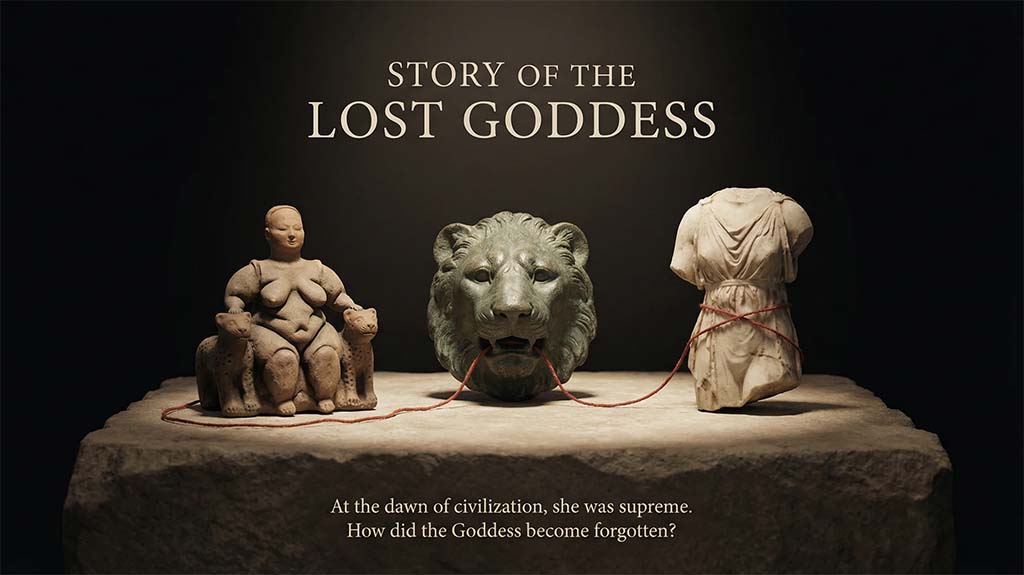
STORY OF THE LOST GODDESS asks what else we got wrong.
The series traces the sacred feminine across every major civilization on earth — from the Neolithic settlements of Anatolia, where female figurines occupied domestic shrines before any temple was built, through the great goddess traditions of Mesopotamia, Minoan Crete, and the Hittite empire, through their systematic fragmentation in Greece, theological erasure in the ancient Near East, absorption into Rome, disguise within early Christianity, and centuries of underground survival in the hands of women who carried the knowledge in plants, cloth, and anonymous shrines. To the living traditions where she still appears today: in Nepal, Brazil, West Africa, the Lakota plains, Siberia, and in the silver headdresses worn by Anatolian brides at this weekend's wedding.
Three registers run in parallel throughout. The archaeological and historical. The living human. And the animal matriarch — because the natural world has been making this argument for millions of years. Female orca grandmothers are the most valuable members of their pods. Elephant matriarchs carry the survival knowledge of their herds. When they die, the community loses its map. This is not metaphor. It is documented biology.
STORY OF THE LOST GODDESS is created and directed by Elif Koyuturk Hazen (Fable Haus). 10 episodes x 26 minutes. In development.
Director Identity
Bio
Elif Koyutürk Hazen is a documentary director and cinematographer working in hybrid nonfiction. She began her career as a camera operator filming extreme sports and adventure stories around the world, a background that shaped a visual style grounded in presence, physicality, and intimacy with place.
She is the director and cinematographer of Guardians of Anatolia, a 20-minute documentary short following the last nomadic Yörük communities of Türkiye, selected for the Mountainfilm Emerging Filmmaker Fellowship. She is currently developing Story of the Lost Goddess, an episodic documentary series examining goddess traditions across Anatolia, the Mediterranean, and the Near East, and is in post-production on Shaereh, a 6-minute art film centered on Iranian women’s expressions of freedom through Sama-inspired movement.
In parallel with her film work, she was selected as an artist for Cambridge University’s Sci-Art program and has exhibited work internationally in museum and gallery contexts as both a visual artist and photographer. Her practice is research-driven, visually grounded, and internationally focused.