Genre
Synopsis
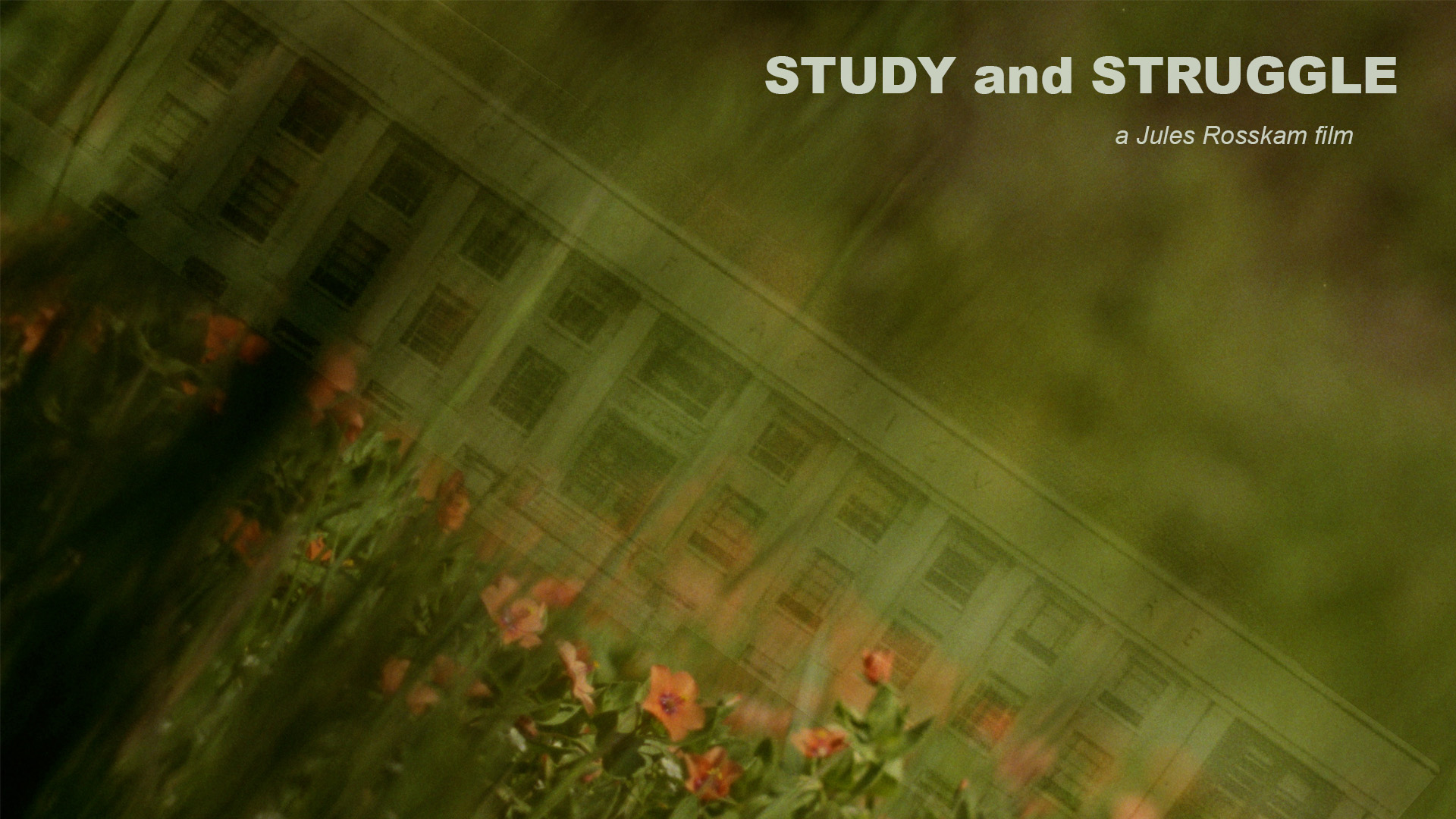
STUDY AND STRUGGLE is a creative nonfiction feature that confronts a central question of freedom movements today: what does liberatory education look like on stolen land inside a nation built from genocide, slavery, militarism, and extraction?
Through four “land-grant” universities—the University of Arizona, the University of Connecticut, Avery Point, South Dakota State University, and the University of California, Riverside—the film excavates the university’s origins in Indigenous dispossession and slavery, while amplifying movements today that are working toward rematriation, reparations, and the abolition of institutional violence. These campuses are not simply educational spaces—they are active infrastructures of empire: built through land theft, enriched by forced labor, and sustained by extraction, militarized policing, and debt.
The film asks: What does it mean to learn inside institutions designed to reproduce systems of domination? And what other forms of study—rooted in sovereignty, autonomy, and collective liberation—already exist both inside and outside of universities?
STUDY AND STRUGGLE is guided by BIPOC thinkers, movement organizers, land defenders, and community historians whose work traces both the long history of institutional violence and the pathways toward freedom that persist alongside it. The film treats study itself as a political practice: one deeply entangled with land, power, and possibility.
Land here is not just territory, it is pedagogy. The film emerges from Indigenous frameworks that regard land as a teacher and a living archive. Through visual language and rhythm, we explore how the university imposes a specific temporality onto land: one of linear progress, extraction, and control. Against that, the film foregrounds land’s own cycles—of dormancy, renewal, and resistance. What might these places have taught us had they not been reshaped to serve institutional goals?
The film also interrogates the built environment of the university. Its spatial design is not neutral—its quads, libraries, surveillance towers, and perimeters are technologies of control that shape who sees and who is unseen, who belongs and who is removable. The film traces how these infrastructures extend logics of private property and the carceral state, enforcing order through enclosure. Yet these same spaces contain cracks, fault lines, where another politics erupts.
Universities have long been sites of refusal. From occupied administration buildings to divestment campaigns, students, faculty, and staff have continually pushed against the institution’s alignment with power. STUDY AND STRUGGLE traces these moments of insurgency not just as isolated eruptions, but as part of a larger rhythm of protest and rest, resistance and regeneration. We explore the spatiality of protest itself—how the gathering of bodies, voices, and care relations creates temporary breaches in institutional time and order.
STUDY AND STRUGGLE is not an exposé. It is a cinematic inquiry into who gets to define knowledge—and who is erased from it. It refuses institutional nostalgia and instead asks: What might we build if study were unbound from empire? If learning returned to land? If struggle was not a crisis, but a form of care?
Through image, sound, and movement, the film opens a threshold—a cinematic study of what we inherit, what we refuse, and what we are called to return to.
Bio
Jules Rosskam is an interdisciplinary artist, filmmaker, and educator. His work explores ethics, embodiment, and the relationship between form and politics, often focusing on trans experience through a trans lens. His work has been shown at the Museum of Modern Art, the Museum of Fine Art Boston, the British Film Institute, Arsenal Berlin, Anthology Film Archives, Film Society of Lincoln Center, the Gene Siskel Film Center, Sundance Film Festival, Thessaloniki Documentary Film Festival, Provincetown International Film Festival, Chicago International Film Festival, and dozens of LGBTQ film festivals worldwide. His work has been supported by Creative Capital, Chicken and Egg Films, The Flaherty Film Seminar, Illinois Arts Council, and the LEF Foundation. He has participated in residencies at Yaddo, ISSUE Project Room, Marble House Project, and PLAYA. His most recent film, DESIRE LINES (2024) won the NEXT Special Jury Award at Sundance, and the Silver Alexander Award at the Thessaloniki International Documentary Festival, among several other jury awards. DESIRE LINES has been called "hypnotic and enduring” by Cinema Daily, “a cinematic breath of fresh air” by Filmmaker Magazine, and “a film with intelligence and heart” by The New York Times. He is also the director of the award-winning films DANCE, DANCE, EVOLUTION (2019), PATERNAL RITES (2018) SOMETHING TO CRY ABOUT (2018), THICK RELATIONS (2012), AGAINST A TRANS NARRATIVE (2009), and TRANSPARENT (2005).