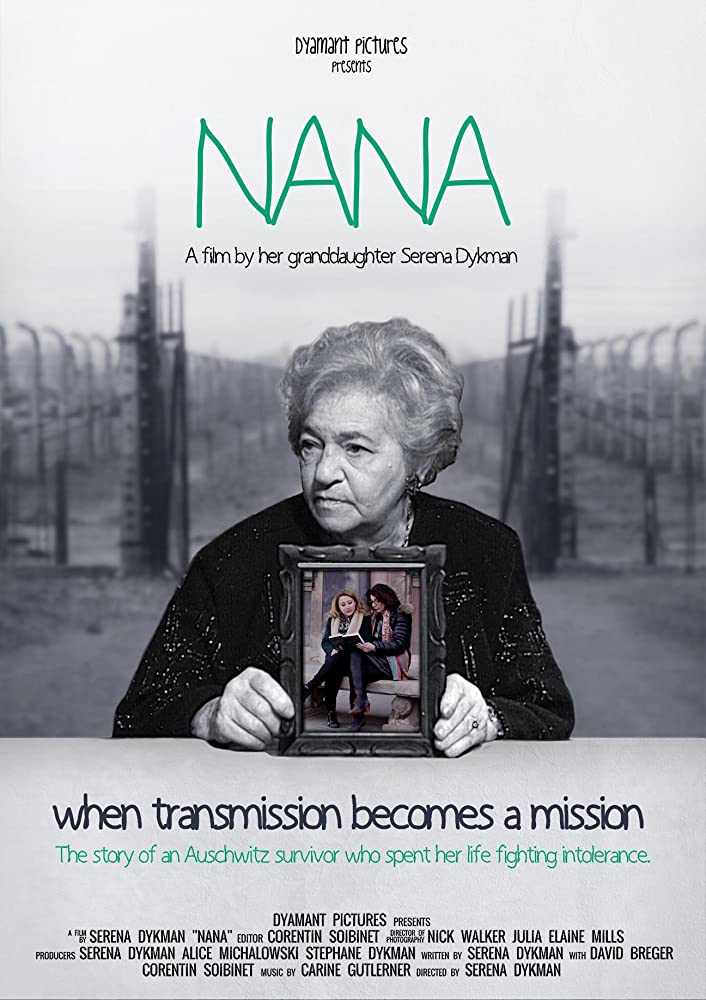
The filmmaker retraces her grandmother's Auschwitz survival story, and investigates how her life-long fight against intolerance can be taught to the new generations.NANA is a feature-length transgenerational documentary. The filmmaker traces her grandmother's Auschwitz survival story, and investigates how her life-long fight against intolerance can be taught to the new generations.
Maryla Michalowski-Dyamant, born in Poland, survived Ravensbruck, Malchow, and Auschwitz, where she was the forced translator of the “Angel of Death”, Dr. Mengele. She dedicated her post-war life to publicly speaking of her survival to the young generations, so that it would never be forgotten or repeated. Alice and Serena, her daughter and granddaughter, explore how Maryla's fight against intolerance can continue today, in a world where survivors are disappearing, and intolerance, racism and antisemitism are on the rise.
Serena Dykman is a New York–based filmmaker and self-described “culture-clasher” who uses storytelling to connect people through humor, heart, and humanity. A proud third-culture kid, she was born in Paris and raised across Brussels, the French Antilles, London, and New York. Her global upbringing fuels her passion for exploring identity and cross-cultural connections.
A graduate of NYU Tisch School of the Arts Film & Television program and a member of the WGA East, Serena has collaborated with renowned talents including
Saul Rubinek (Hunters), Shahadi Wright Joseph (Us), and James V. Hart (Hook, Contact). Her films have screened at more than eighty international festivals, including Oscar-qualifiers, and earned over twenty-five awards, including a Webby Award and a Humanitas Prize nomination.
At just 23, Serena directed her debut feature documentary NANA, about her
grandmother’s survival of Auschwitz. The film was theatrically released by First Run Features and led her to speak internationally at institutions such as the European Commission and Amnesty International.
In 2024 alone, she directed three shorts—BABKA, M.U.B., and AT SEE—across narrative and documentary. She has collaborated with major cultural institutions including the Guggenheim Museum and the New York City Ballet Choreographic Institute, and has worked on film projects across the world, from Myanmar to Poland.